Best Paper Size for Ludo Board Printing: A3 vs A4 Explained
Here's a mistake I see constantly: someone designs a gorgeous custom board, prints it on A4 at home, and then squints at it. The tokens cover entire squares. The center text is a smudge. The kids fight over whose turn it is because nobody can see the board properly. The design was fine — the size was wrong.
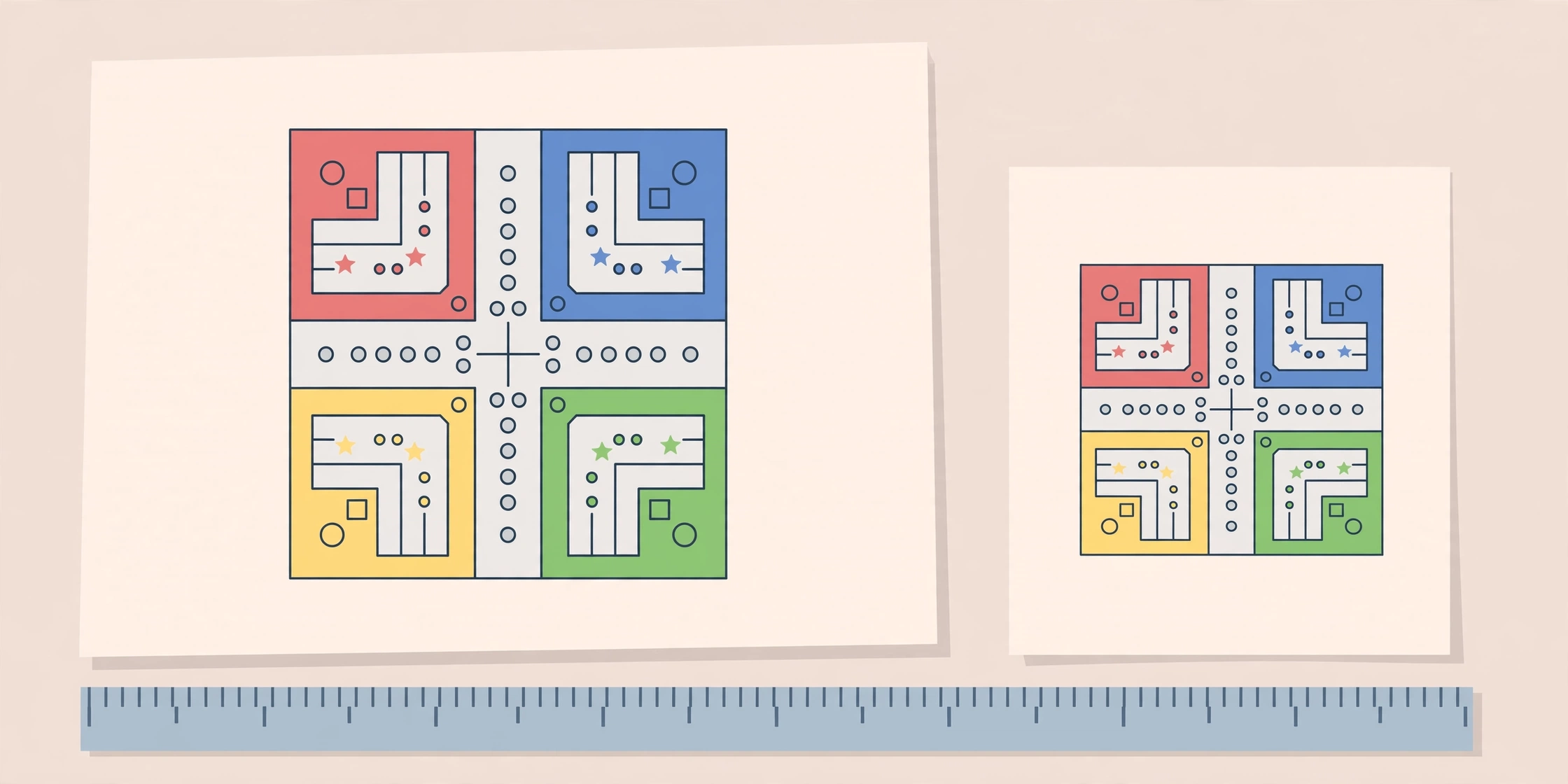
Paper size is the single most underrated decision in board printing. Get it right and everything else — readability, token fit, the "wow" factor — falls into place. Here's the complete breakdown.
The numbers that matter
A Ludo board is square, and paper isn't — so the board can only be as big as the paper's shorter side (minus margins). Let's compare the realistic options:
| Paper | Sheet size | Max board size | Square size (approx) | Typical print cost |
|---|---|---|---|---|
| A4 | 21 × 29.7 cm | ~19 cm | ~1.1 cm | ₹10–25 |
| A3 | 29.7 × 42 cm | ~28 cm | ~1.7 cm | ₹60–120 |
| A2 | 42 × 59.4 cm | ~40 cm | ~2.4 cm | ₹200–400 |
Square size is the number that actually matters for playability. A standard Ludo token base is about 1.5–2 cm wide. On A4, tokens overhang their squares — playable, but fiddly. On A3, everything sits comfortably. On A2, it's luxurious.
A4: when it makes sense
Don't dismiss A4. It's perfect for: travel boards (fits in a bag), kids' personal boards (small hands, small board), test prints before committing to a big run, and return gifts where you're printing 100+ pieces and every rupee counts. Our home printing guide walks through getting the best possible A4 print from a home printer.
A4's weakness is readability of custom text. If your design has family names in the center medallion, check them at actual size before printing 150 copies. What looks crisp on your phone can be mush at 19cm.
A3: the sweet spot for most people
For a family board — the one that lives on the dining table and gets played every weekend — A3 is the answer. At ~28cm, squares are ~1.7cm: tokens sit properly, text is readable at arm's length, and four adults can crowd around comfortably. Print shops handle A3 routinely; it's their bread and butter. Ask for 250 GSM art paper and you'll get something that feels substantial, not flimsy.
Cost-wise, A3 is the value king. You're paying 3–5x the A4 price for roughly 2x the board area — but the playability jump is more like 5x. Diminishing returns only kick in above A3.
When to go bigger (A2 and beyond)
A2 (~40cm board) is for special cases: a permanent family heirloom board, a gift where "wow" matters more than practicality, or players with vision difficulties who need large squares. It's also the right call for wedding return gifts if your budget allows — a big board feels premium in a way small ones can't.
Beyond A2, you're into flex/banner printing territory. Fine for events and societies, overkill for home. The 2048px PNG from the board designer stays sharp up to about 18 inches; beyond that, talk to the print shop about vector scaling.
Paper thickness matters as much as size
A big board on thin paper is a sad thing — it warps, it tears at folds, it feels cheap. Match thickness to size: A4 works on 120–160 GSM, A3 wants 200–250 GSM minimum, A2 should be 250–300 GSM or mounted on board. And whatever size you pick, laminate it. A laminated A3 board survives years of play; an unlaminated one survives months. Our lamination guide covers the options and costs.
The 30-second decision guide
Printing at home right now? A4. It's what your printer takes.
One family board for regular play? A3, 250 GSM, laminated. Done.
Bulk return gifts? A4, 250 GSM, laminated — the economics win.
A gift to impress? A3 or A2, thick paper, laminated, in a proper box.
Still unsure? The printing FAQ answers the common follow-ups on paper, shops, and cost.
Design for your size
One last tip: design with your final size in mind. If you're printing A4, keep center text short and bold — there's no room for subtlety. If you're going A3, you can afford longer names and finer details. The designer preview shows everything larger than life; mentally shrink it to your actual paper size before you hit download. Your future self, holding the actual print, will thank you.
The print shop conversation: what to actually say
Walking into a print shop and saying "I want to print a Ludo board" gets you a blank stare. Here's the exact script that works:
"Bhaiya, A3 size, single side color print chahiye. Paper 250 GSM art paper. Mere paas ready PNG file hai, 2048 pixels. Pehle ek test print karke dikha do." Then look at the test print and check: colors (do they match your screen roughly?), sharpness (is the center text crisp?), and margins (is anything cut off?).
Then: "Lamination bhi karna hai, 125 micron pouch. Dono ka bulk rate laga do." If you're printing 10+, always ask for bulk rate. Shops expect it — their listed price is the single-copy price, and nobody pays that for quantity.
Three questions to ask before you commit: (1) "Paper kaunsa use karoge?" — you want art paper, not regular copier paper. (2) "Color laser ya inkjet?" — either is fine for A3, but laser is more water-resistant. (3) "Kab tak milega?" — same-day for small quantities, 1–2 days for 50+.
Red flags: a shop that won't do a test print, a shop that can't tell you the paper GSM, or a price that seems too good — ₹20 for an A3 color print means they're using thin paper and you'll feel it.
Digital vs offset: when quantity changes everything
Up to ~200 copies, digital printing (the big laser printer in the corner shop) is your friend — no setup cost, quick turnaround. Beyond 200–300 copies, ask about offset printing. Offset has a setup cost (plates), but the per-copy price drops dramatically — we're talking ₹15–25 per A3 sheet at 500+ quantity on decent paper.
For most people reading this, digital is the answer. Offset only enters the picture for big weddings, schools, or corporate orders. But it's good to know the threshold exists, because the price difference at 500 copies is the difference between ₹30,000 and ₹12,000. If you're planning something big, get quotes for both.
A word on orientation and margins
One technical detail that trips people up: Ludo boards are square, but A4 and A3 are rectangles. When you print "fit to page," the board fills the short side and you get white strips top and bottom. That's normal — don't try to stretch the image to fill the page or your squares become rectangles and the whole board looks wrong. Those white strips are actually useful: trim one into a bookmark, or print the family name large across the bottom strip as a header. Waste nothing.
🎨 Design at any size — free
The 2048px PNG prints sharp from A4 to A2. Pick your size, download, print.